Leather Cleaning by Proclean Hong Kong:
Care, Not Just Cleaning
Leather furniture is an investment — in quality, in aesthetics, and in longevity. But leather is a natural material that reacts to its environment, and in Hong Kong’s humid, warm, and polluted urban climate, that environment is a challenging one. Dust, body oils, airborne pollutants, and the constant cycle of air-conditioning and humidity place ongoing stress on leather surfaces. Without the right care at the right intervals, that investment degrades — slowly at first, then visibly, then expensively. Proclean Hong Kong’s leather cleaning and conditioning service is designed to prevent that trajectory, not reverse it after the damage is done.
Why Leather Demands a Completely Different Approach
Leather is not a fabric. It is processed animal hide — a natural material that breathes, absorbs, and responds to its environment in ways that synthetic and woven upholstery do not. This makes it uniquely rewarding when cared for correctly, and uniquely vulnerable when treated with the wrong products or techniques.
The core mistake most people make with leather is treating it like a hard surface — wiping it down with water, general-purpose cleaners, or household sprays. Water alone can cause leather to stiffen and crack as it dries. Alcohol-based cleaners strip the natural oils that keep leather supple. Harsh detergents break down the surface coating on protected leather and penetrate unprotected leather to cause permanent discolouration. Once leather is cracked, dried out, or chemically damaged, restoration is costly and never fully restores the original condition. Prevention is not just preferable — it is significantly cheaper.
Proper leather care involves three distinct actions: cleaning (removing surface soiling without stripping oils), conditioning (restoring moisture and flexibility to the hide), and protecting (applying a barrier against future soiling, UV exposure, and environmental stress). Most DIY leather cleaning addresses only the first, inadequately. A professional service addresses all three.
How Hong Kong’s Climate Affects Leather Furniture
Leather ages faster in Hong Kong than in temperate climates for several compounding reasons.
High humidity during the wet season (May to September) creates conditions in which mould and mildew can develop on leather surfaces, particularly on pieces positioned near windows, exterior walls, or areas with limited airflow. Leather that is not regularly cleaned provides the organic surface residue — body oils, dust, skin cells — that mould spores need to establish. The Hong Kong Observatory records average relative humidity consistently above 75 percent for six months of the year — well within the range where biological growth on organic surfaces becomes a genuine risk.
Air-conditioning creates the opposite problem for the other half of the year. Hong Kong interiors run air-conditioning almost continuously from May through October, and the dry, cooled air progressively depletes the moisture content of leather. Leather that is not conditioned regularly becomes progressively less flexible, and once the natural oils are depleted below a certain level, cracking begins — first in high-flex areas like seat creases and armrests, then across the surface.
Urban air pollution deposits fine particulate matter on all surfaces, and leather — being slightly tacky — attracts and holds it. Body oils from regular use create a surface layer that traps this particulate, and over time the accumulated soiling penetrates the leather’s surface pores, dulling colour and accelerating surface degradation.
Understanding Your Leather Type
Leather is not a single material — it is a category. The cleaning and conditioning approach must be matched to the specific type of leather, because what works on one can damage another.
Full-Grain and Top-Grain Leather
The highest quality leathers, with visible natural grain texture and minimal surface coating. These are the most durable but also the most absorbent — they respond readily to conditioning and show the benefits of regular care most visibly. They also show neglect most clearly. Cleaning must use pH-neutral, leather-specific products only.
Protected and Pigmented Leather
The most common type in residential furniture, with a polymer coating applied over the hide to provide uniform colour and resistance to everyday soiling. More forgiving than aniline leathers but still sensitive to alcohol, solvents, and abrasive cleaning. The coating can be worn through by incorrect technique, exposing the untreated hide beneath.
Aniline and Semi-Aniline Leather
Dyed leather with minimal or no surface coating — the most natural-feeling but the most vulnerable to staining and moisture. Requires the most cautious cleaning approach and the most regular conditioning. Any liquid left on aniline leather will mark unless addressed immediately.
Bonded Leather
Not genuine leather — bonded leather is a composite material made from leather scraps and fibres bonded to a polyurethane or vinyl backing. It is common in entry-level furniture and requires entirely different treatment. Bonded leather is prone to peeling and delamination and cannot be restored in the same way as genuine leather once degradation begins. Proclean identifies bonded leather at assessment and advises clients accordingly — the appropriate expectation is different from genuine leather care.
The Proclean Leather Cleaning and Conditioning Process
Assessment and Leather Identification
Before any product is applied, our technicians assess the leather type, surface condition, and any existing damage — cracks, discolouration, worn areas, or mould growth. This determines the appropriate cleaning agents, conditioning products, and technique. A patch test is conducted on an inconspicuous area where material reaction cannot be predicted with certainty.
Gentle Surface Cleaning
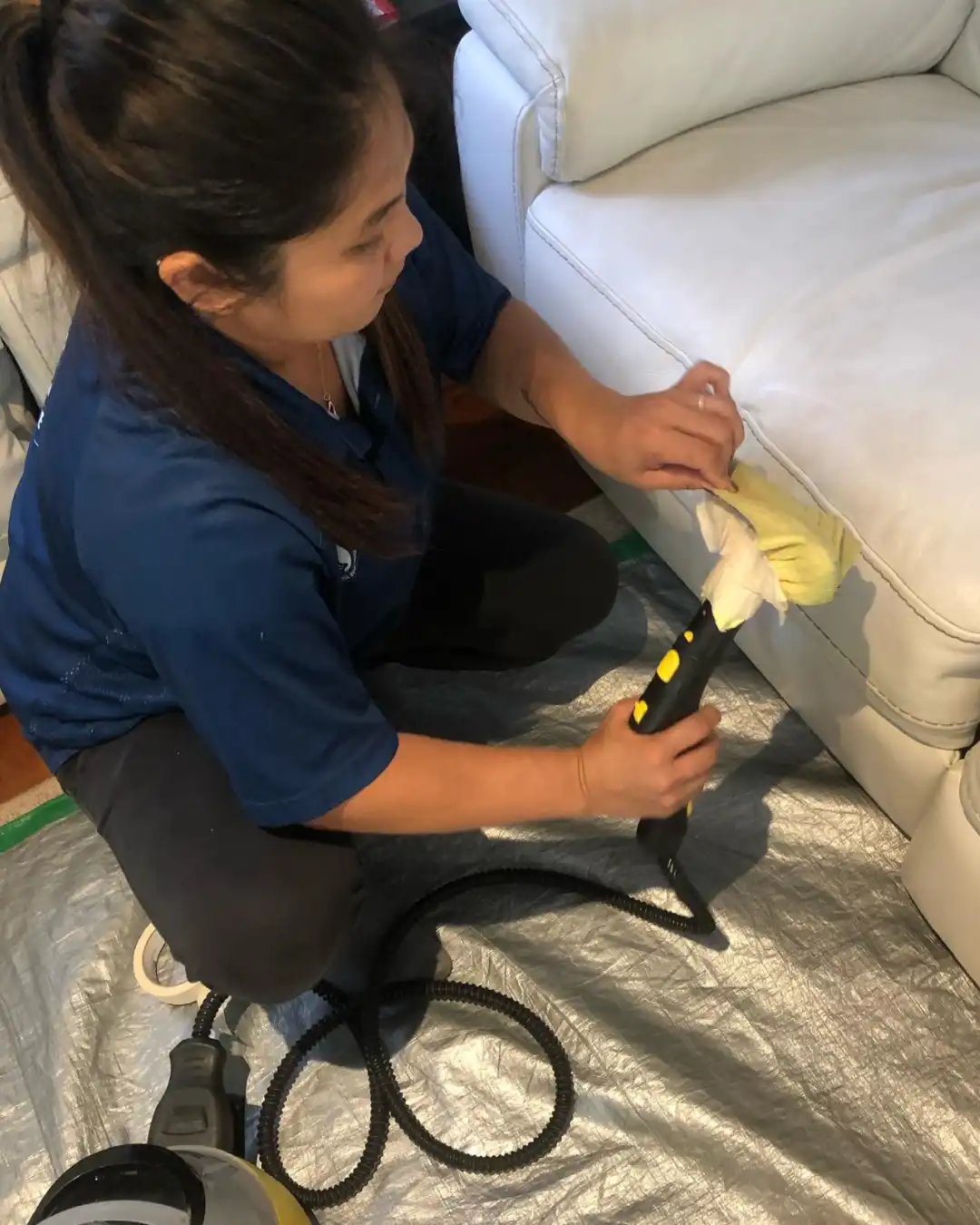
Surface soiling — body oils, dust, and environmental deposits — is removed using pH-neutral, leather-specific cleaning products applied with soft cloths and gentle technique. No circular scrubbing, no excess liquid, no solvent-based products. The goal is thorough cleaning without any disruption to the leather’s surface coating or the hide beneath it.
Conditioning and Moisture Restoration
After cleaning, a leather conditioner matched to the leather type is applied and worked into the surface. Conditioning replenishes the oils and moisture that daily use and air-conditioning progressively deplete, restoring suppleness and flexibility to the hide. This is the step most DIY approaches skip entirely — and it is the most important for long-term leather health.
Protection Application
A leather protector is applied as the final step, creating a barrier against future soiling, moisture penetration, and UV degradation. This extends the period between professional cleans and makes daily maintenance more effective. The protector is compatible with the leather type and does not alter the surface appearance or texture.
Book a Leather Care Service in Hong Kong
Cleaning, conditioning, and protection for all genuine leather furniture — across all Hong Kong districts.
What We Clean and Condition
Proclean’s leather care service covers all genuine leather furniture in residential and commercial settings across Hong Kong:
- Leather sofas and sectionals — the highest-use leather items in most homes, and the first to show the effects of neglect in seat creases, armrests, and headrests
- Armchairs and accent pieces — often positioned near windows and more exposed to UV degradation and humidity variation
- Office and executive furniture — leather desk chairs and boardroom seating in commercial environments absorb significant body oil and soiling from daily high-contact use
- Leather headboards and bedroom furniture — proximity to sleeping occupants means regular transfer of hair products, moisturisers, and perspiration
For fabric upholstery and sofas, our approach differs significantly — see our four-step deep-clean upholstery process for details on how we treat fabric furniture.
The Cost of Neglect vs the Cost of Care
Leather restoration — attempting to repair cracked, dried, or discoloured leather after the fact — is significantly more expensive than preventive maintenance, and the results are never equivalent to leather that has been well maintained from the start. Professional leather restoration in Hong Kong for a standard three-seat sofa can cost several times more than a regular care service, and even the best restoration leaves evidence of the damage.
The practical case for regular professional leather care is straightforward: a quality leather sofa maintained correctly lasts fifteen to twenty years and retains its appearance throughout. The same sofa neglected in Hong Kong’s climate may begin cracking visibly within five years. The cost of two professional care services per year is a fraction of early replacement.
How Often to Care for Leather in Hong Kong
In Hong Kong’s climate, leather furniture benefits from professional cleaning and conditioning twice a year — ideally aligned with the seasonal transitions we describe in our seasonal deep cleaning guide. Before the wet season, to clear surface soiling before humidity rises. After the wet season, to address any mould or moisture damage and recondition leather dried by months of air-conditioning.
Between professional services, wipe leather surfaces weekly with a dry or very lightly dampened soft cloth to remove dust and surface soiling before it has time to penetrate. Keep leather out of direct sunlight where possible — UV exposure is one of the fastest drivers of colour fading and surface drying. Avoid placing leather furniture directly against exterior walls during the wet season, where condensation is more likely.
Book Your Leather Care Service
Proclean Hong Kong’s leather cleaning and conditioning service is available for all genuine leather furniture types across all major Hong Kong districts. Whether your leather is showing early signs of drying, has developed surface soiling from years of use, or simply needs a proper professional care cycle to stay in premium condition, we provide the assessment and treatment it requires. Contact us to arrange a visit or ask about combining leather care with our broader home deep cleaning service.